Turning Convenience Store Foodservice Wait Into Value
Admin
September 22, 2026
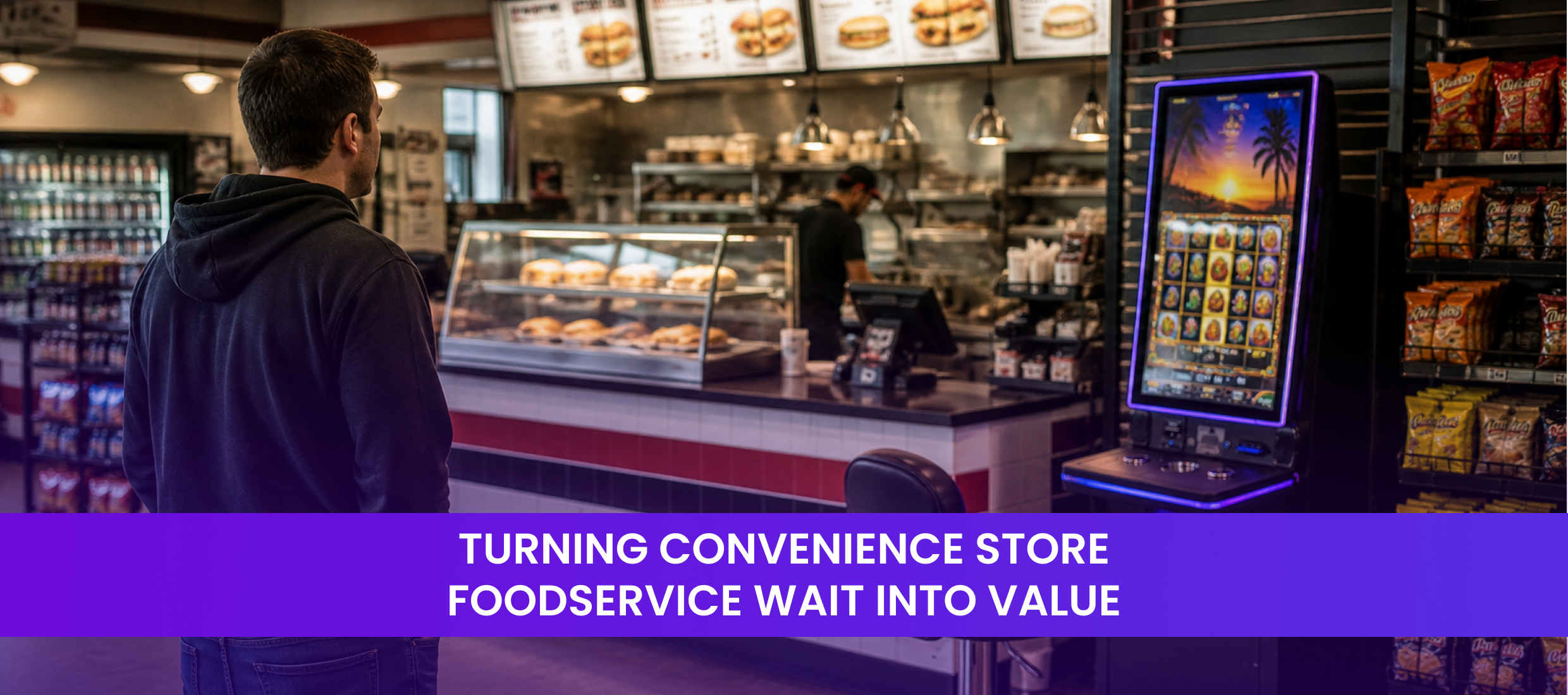
The order takes six minutes. The customer just stands there.
Maybe they check their phone. Maybe they stare at the fountain machine. Either way, they're stuck at your counter with nothing to do until their name gets called.
Convenience store foodservice keeps growing because customers want it. Tacos, sandwiches, hot cases, and breakfast counters have become standard at independent stores. The menu has gotten real, and so has the wait that comes with it.
This is for the owner who already cooks something at the counter. It's not a case for building a food program from nothing. It's about the minutes after the order goes in.
Pressed for Time? The Gist on Convenience Store Foodservice Wait
- The wait is structural, not a flaw. Made-to-order convenience store foodservice takes a few minutes to prep, every single time.
- Most advice tries to erase the wait. Kiosks, apps, faster prep. None of it helps the customer standing there today.
- Placement decides the outcome. A skill game machine near the pickup window turns standing around into something else.
- This isn't a food-program pitch. If you already cook something, this is about what happens after you ring it up.
- The fix doesn't need staff. The machine runs on its own while the order cooks.
Why Convenience Store Foodservice Always Comes With a Wait
Foodservice made up 28.5% of convenience store in-store sales in 2025, and close to 40% of in-store gross profit. That's not a side item anymore. For a lot of independent stores, it's the main event.
One 2026 industry audit found close to six in ten stores cooking to order. Tacos, sandwiches, and hot cases all fit that same pattern. The wait comes standard with the menu now, whether the store planned for it or not.
That wait is not a flaw in your operation. It's the cost of serving food the way customers actually want it served, and it shows up at every counter doing real cooking instead of just stocking shelves.
The stores skipping made-to-order food skip the wait too. They also skip the margin that comes with it. Most owners have already made that trade on purpose, and they're not looking to undo it just to shave a few minutes off the ticket.
What Happens in Those Minutes Right Now
Most foodservice advice treats the wait as a problem to erase. Faster prep lines, order-ahead apps, and digital menu boards all aim at the same goal. Get the customer out the door quicker.
None of that helps the guy standing at your counter this afternoon. He ordered. He's waiting. He's bored.
That's dead time inside your store. No line item tracks it, but it's a real cost.
Picture what actually happens during those minutes. He checks his phone for the third time. He glances at the drink case he already passed on, then wonders if he should've just grabbed a hot dog off the roller grill instead.
None of that helps your ticket average, and none of it makes the wait feel shorter. A bored customer isn't a loyal one. Just a guy killing time until his name gets called.
The Customer Who Almost Leaves
Sometimes the wait costs you more than a bored expression. A customer glances at the counter, checks the time, and wonders if it's worth it today.
He doesn't walk out often. But when the wait feels long with nothing to fill it, he remembers that feeling the next time he's deciding where to stop for lunch.
A machine near the pickup window changes what that memory looks like. The wait still exists. It just stops being the only thing he notices about the visit.
Where the Machine Goes Relative to the Pickup Window
Sightline is the whole game here. A skill game machine within eyeshot of the pickup counter catches the customer at the exact moment he has nothing else to do.
Don't put it by the register. That creates a different kind of wait, and crowding that line trades one problem for another.
Don't tuck it in a back corner either. A machine nobody can see from the counter isn't solving this problem. It's just floor space with a plug.
Put it where a bored customer can already see it from where he's standing. That's placement doing its job.
Space is usually less of a constraint here than owners expect. A counter area with room for customers to wait already has room for a cabinet nearby. The machine doesn't need to compete with shelving or a cooler for that same spot.
A good spot usually works for more than one kind of customer, too. Someone waiting on a coffee or a fountain drink notices the same machine the taco order does.
Peak Entertainment installs and maintains the machine, so the sightline decision is really the only call you have to make. What makes one location outperform another walks through what separates a good spot from a great one.
What This Isn't
This isn't a case for building a food program from scratch. That's a different conversation, with different economics and a longer runway.
It isn't the general c-store playbook either. That guide covers the whole store, not just the counter.
This post stays narrow on purpose. You already cook something. This is about the minutes right after the order goes in, and nothing broader than that.
What the Machine Does While the Order Cooks
The machine doesn't need a staff member's attention to run. One real question worth asking is whether new equipment needs babysitting, and this doesn't.
It works whether or not anyone's watching it, which matters when your cook is buried in orders. Your staff has enough to manage without adding another thing to check on during a lunch rush.
It also doesn't care what hours the kitchen keeps. A breakfast counter that closes at eleven still has a machine running at three in the afternoon, catching whoever's waiting on something else entirely.
Nothing about the food side changes because the machine is there. Your cook still runs the counter the same way, on the same schedule, with the same recipe cards.
Most stores adding machines like this aren't chains with foodservice budgets and dedicated staff. They're independents figuring out what to do with a customer who's already standing there.
A store with a hot case and a lunch rush has more waiting customers than a store with just a cooler wall. Turning that waiting time into something else is the whole point.
Most Texas convenience stores are still independently run. Close to two-thirds are operated by owners with ten stores or fewer. You're not solving a chain-level problem. You're solving your own counter, your own wait, and your own floor space.
Your Counter Already Has the Opportunity Built In
You didn't create this wait, and you're not going to engineer it away. It exists because your food is worth waiting for, not because something in your operation is broken.
The only real decision left is what a bored customer does with those six minutes. Peak Entertainment handles the machine end entirely, from installation through ongoing upkeep. The placement conversation is specific to your counter, not a generic template pulled from a chain's floor plan.
There's no upfront cost to find out what that conversation looks like. You keep running your counter exactly the way you already run it, and the machine becomes a small piece of in-store entertainment layered onto a visit you were already hosting.
If the wait already exists at your store, it's worth talking through where a machine would actually sit and what it would change for the customer standing there.
Frequently Asked Questions
1. Where should the machine sit relative to the pickup window?
Close enough to see from the counter, but not blocking the register line. The customer waiting on food needs a clear sightline, not a detour through a second line.
2. What if the food counter is only staffed part of the day?
Not usually an issue. The machine runs on its own regardless of whether the kitchen is active, so it's still doing its job during the hours the counter is closed.
3. Does the machine slow down the food line?
No. It sits near the pickup window, not inside the prep or order path, so it has no effect on how fast food gets made or handed off.
4. Does this work with a hot case instead of a made-to-order counter?
Yes, with one difference. A hot case wait is shorter and less predictable, so placement matters even more since the machine needs to catch attention fast.
5. How long does the wait need to be for this to make sense?
A few minutes is usually enough. Most made-to-order items run in that range already, which is why placement matters more than exact timing.
6. Does the order-ready call interrupt someone mid-game?
Not really. Skill game machines run in short rounds, so a customer can step away when their name is called without losing anything mid-play.
More Into
Announcements
Trivia Night vs. a Skill Game Machine: What It Really Costs
Every slow-night article says the same thing: run trivia.
Why Convenience Store Profit Margins Depend on Experience
A rival's price sign drops ten cents overnight. You can't match it and stay open.
Behind the Rise of Gas Station Skill Games in Texas
Fuel-only visits leave little time to sell. A driver pumps gas, taps a card, and pulls out.
Every Dead Corner Idea for Texas Bars, Ranked and Compared
That corner by the hallway sits empty every night. A pool table used to be there. Nobody replaced it
Improving Workplace Culture: Managing Burnout in Texas Bars
Running a single-location bar or retail spot in Texas is a high-stakes balancing act.
Stop Micromanaging: Guide to Bar Manager Duties and Responsibilities
Move from constant supervision to strategic oversight in three distinct phases.
Seating for Success: How Bar Stool Comfort Drives Sales
Bar stool is a piece of equipment that can simultaneously speed up a tab or kill a customer’s night.
Reclaiming Your Sanity: The Texas Owner’s Anti-To-Do List
True leadership is not about doing every job. It is about building a machine that runs without you.
How to Schedule Staff Effectively During a Holiday Meltdown
It starts with a vibration in your pocket at 3:00 PM on a Friday in December.
Is it Time to Expand? 5 Signs You're Ready to Grow Your Business
Thinking about opening a second location?
Staff Recognition Ideas: Party, Bonus, or Perks That Work?
Do you give your team a check they'll forget by Jan, or throw a party they not even want to attend?
Build a Championship Bar Staff: A Fantasy Football Guide
What if fantasy football draft strategy held the secret to solving your biggest staffing headache?

How to Make Your Business Stand Out in a Crowded Texas Market
This guide will show how to make your business stand out by uncovering the unique advantage you have
Service vs. Hospitality: The Secret to Customer Loyalty
Is your business a vending machine or a living room?
How to Increase Convenience Store Sales: A Texas Owner's Guide
If you want to understand how to increase convenience store sales, you must plug that leak.
The "Flow State" Secret to Keeping Customers Longer
That blue light is the single biggest drain on your per-patron revenue, and it’s time to fight back.
A Texas Bar Owner's Guide to Conquering Business Owner Burnout
That feeling of constant exhaustion, cynicism, and the nagging sense that you have to do everything.
How a Skill Game Machine Brings in New Faces (Not Just Regulars)
If you run a bar or restaurant in Texas, you know the comfort of familiar faces.
What Texas Regulars Crave: A Guide to Customer Retention
Most content on customer retention strategies centers on loyalty programs or demographic guesses.
Is Skill-Based Gaming Right for Your Business? Get the Answer Now.
It’s easy to think skill-based gaming machines are a slam-dunk for every Texas business.
How Skill-Based Gaming Fits Naturally Into Bar Culture
Skill machines are popping up in local venues, and they’re not just earning attention.
Skill-Based Gaming in the Inflation Era: Earn Passive Revenue
Inflation continues to hit small and mid-sized businesses hard.
Why Skill Based Gaming Machines Are Boosting Guest Retention
Businesses across Texas, especially in Dallas, are turning to a modern solution: skill-based gaming
Truck Stops Are the New Hotspot for Texas Skill Games
Across Texas, truck stops are evolving into prime destinations for skill-based gaming
How Gaming Machines Can Turn Waiting Customers into Buyers
The concept: often called "dwell time", play a major role in sales psychology.
Inside Slot Machines: Mechanics & Winning Potential
Did you know that modern slot machines process over 1000 mathematical calculations per second?
How Gamification Transforms Hospitality for Small Businesses
Gamification has emerged as a game-changer in the hospitality industry.
Ready to partner with us?

Contact
(+1) 855-484-1400
contact@peakentertainment.com
sales@peakentertainment.com
Follow us


Peak Entertainment © All Rights Reserved • Terms of Use • Privacy Policy